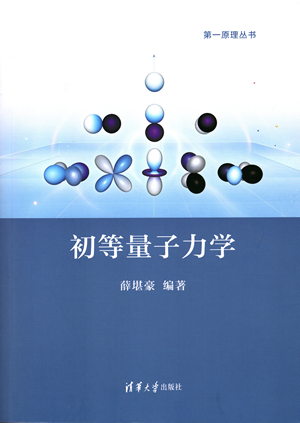
To address the common challenges of introductory quantum mechanics, this book aims to consolidate and fill gaps in the relevant mathematical and physical foundations, present derivations in greater detail, and is tailored to both physics and non-physics undergraduate majors. Chapter 1 integrates the functional analysis, variational methods, and classical mechanics background needed for introductory quantum mechanics. The remaining eight chapters cover the content of an undergraduate quantum mechanics course, including wave-particle duality and de Broglie relations, the time-dependent and stationary Schrödinger equations, one-dimensional stationary-state problems, angular momentum, the formal theory of quantum mechanics, representations, Dirac notation, perturbation theory and variational methods, scattering, spin, properties of identical particles, and the emission and absorption of light. Appropriate chapters also include introductions to the Dirac equation, elementary particles, and the Born expansion.
In analytically solving the Schrödinger equation, the book emphasizes building a systematic understanding based on abstract function spaces and orthogonal polynomials on specific intervals, striving to alleviate readers' mathematical difficulties. It can serve as a quantum mechanics textbook or teaching reference for undergraduate physics programs and related engineering programs such as electronic science and technology, optical engineering, integrated circuit science and engineering, and materials science and engineering. It is also suitable for self-study by readers with a foundation in calculus, linear algebra, and college physics.